Translate

13 September 2024

Unveiling the 'Marocchinate'*: The Tragic Echoes of WWII in Italy

Introduction

In the tumultuous aftermath of World War II, many stories of suffering and hardship have emerged from the shadows of history. One such harrowing chapter is what is known as 'Marocchinate'—a series of brutal acts (mass rapes, killings, looting, and all kinds of violence perpetrated by French colonial troops (Corps ExpĂ©ditionnaire Français, or French Expeditionary Corps - CEF), serving with the Allies) committed by colonial troops from French Morocco in Italy during the closing years of the conflict. These events, deeply etched in the collective memory of the affected communities, highlight the complex interplay of war, colonialism, and human suffering. This blog post delves into this tragic story by exploring the causes, impacts, and ongoing legacy of these dark episodes in Italian history.

Historical Context

These horrific events occurred primarily between 1943 and 1944, during the latter stages of World War II, as the Allies advanced through Italy following the Italian armistice (signed on 8 September 1943) with the Allies. The French, who had joined the Allies, included many troops who were part of the French Colonial Army. These troops, predominantly Berbers (North Africans) and Arabs from Morocco were instrumental in the campaign to liberate Italy from German occupation. However, the chaos of war and the strain of prolonged conflict set the stage for tragic events.

The Atrocities

As Allied forces pushed north through Italy, they encountered fierce resistance from German troops and their Italian allies. Amidst the chaos,  the CEF soldiers deployed to Italy committed a series of atrocities against Italian civilians. These acts of violence were mainly concentrated in the regions of Lazio, Campania, and especially around the town of Montecassino. The troops, who were already facing harsh conditions and brutal fighting, were reportedly responsible for numerous rapes, murders, and other acts of violence against the local population. Eyewitness accounts and post-war investigations reveal a landscape scarred by cruelty. Villages were devastated, and countless individuals, including women and children, suffered unimaginable horrors. 

The Aftermath and Response

In the immediate aftermath of the ‘Marocchinate’, the Italian government, along with the Allied forces, faced a significant challenge in addressing the devastation. While there were some efforts to provide relief and justice, the complexity of the situation and the sheer scale of the violence meant that many survivors struggled to obtain redress.

For decades, the ‘Marocchinate’ remained a largely unspoken chapter of World War II history, overshadowed by the more widely known atrocities and the broader narrative of the war. It was only in the latter half of the 20th century that efforts began to shed light on these events, driven by historians, survivors, and advocates who sought to ensure that the victims' stories were heard and acknowledged.

Contemporary Reflections

The legacy of the ‘Marocchinate’ continues to resonate in contemporary Italy. Survivors and their descendants still grapple with the trauma and injustice of these events. Memorials and commemorations have been established to honour the victims and provide a space for remembrance and reflection. Additionally, the events have prompted broader discussions about the impact of colonialism, the nature of wartime violence, and the need for historical reconciliation.

Conclusion

The ‘Marocchinate’ remain a poignant and sad reminder of the capacity for violence in the chaos of war and the deep scars it can leave on communities. Understanding this tragic chapter in Italian history is crucial not only for honouring the memory of the victims but also for fostering a broader dialogue about the consequences of conflict and the ongoing quest for justice and reconciliation. By bringing these stories to light, we contribute to a more comprehensive understanding of the past and a more empathetic future.

*Today, the term ‘marocchinate’ is considered inaccurate due to its generalising and misleading nature. Originally used to describe war crimes such as mass rapes and killings committed by French colonial troops from Morocco during World War II, it unfairly attributes these actions to all Moroccan soldiers rather than acknowledging that they were carried out by a specific subset of troops within the French Expeditionary Corps. This oversimplification distorts historical accuracy and unfairly stigmatises an entire ethnic group. Furthermore, the term can perpetuate cultural and ethnic prejudices by reinforcing negative stereotypes about Moroccan people and Berbers. The lack of nuance in the term's application overlooks the complex nature of the colonial forces involved. It fails to address the broader historical context, thus contributing to misunderstanding and bias.

Film:

The film “La Ciociara/Two Women” (1960), directed by Vittorio De Sica and based on the novel by Alberto Moravia, depicts the traumatic experiences of a woman and her daughter during World War II as they face the brutal realities of war and the struggle for survival in occupied Italy.


I took this photo on 3 August 2023 in Campodimele (LT), Italy.


Further reading:

https://www.marocchinate.org

Catallo, Stefania. La memoria scomoda della guerra: Le marocchinate. Rome: Universitalia, 2017.

Ciotti, Emiliano. Il dossier segreto dei crimini francesiLecce: Youcanprint, 2020.


08 August 2024

The Shocking Circeo Massacre of September 1975

On the night of 29 September 1975, a small coastal town southeast of Rome became the setting for one of the most brutal and shocking crimes in the country’s modern history. The Circeo Massacre, as it came to be known, not only exposed the vicious cruelty of its perpetrators but also highlighted deep-seated issues of misogyny, class privilege, and corruption within the Italian justice system. The tragedy left an indelible scar on the national psyche, its impact resonating for decades.

The Victims: Rosaria Lopez and Donatella Colasanti

The events of that night began with two young women, Rosaria Lopez, 19, and Donatella Colasanti, 17. Both from proletarian backgrounds in Rome, they were lured into a trap by three wealthy young men: Angelo Izzo, Gianni Guido, and Andrea Ghira. The men promised the girls a fun evening at a beach house in Circeo, a scenic town known for its beauty and tranquillity. But the reality that awaited them was a nightmare of unimaginable brutality.

The Crime: A Night of Horror

Upon arriving at the secluded villa, the atmosphere quickly turned sinister. The men, fuelled by a toxic mix of drugs, alcohol, and a sense of entitlement, unleashed their sadistic desires on the two girls. For nearly 36 hours, Rosaria and Donatella were subjected to relentless torture, sexual assault, and violence. The attackers, all in their early twenties and from affluent Roman families, saw themselves as untouchable, and their actions were driven by a deep-seated disdain for the women they considered inferior.

Rosaria Lopez bore the brunt of the assault. The extent of the violence inflicted upon her was so severe that it led to her death. Her body was found submerged in a bathtub, a grim testament to the sadistic nature of her attackers. The men, believing Donatella had also died from the brutal beatings and the suffocation attempt, heartlessly packed both women’s bodies into the trunk of a Fiat 127, planning to dispose of them later.

The Escape: Donatella Colasanti’s Survival

In a twist of fate that turned the horror into a story of survival, Donatella Colasanti, though gravely injured, was not dead. She had faked death to escape further torture, a decision that ultimately saved her life. On the night of 30 September 1975, at approximately 22:50, after the men left the car parked in Via Pola located in the Trieste neighbourhood of Rome, she regained consciousness and, despite her severe injuries, managed to make enough noise to attract the attention of a passerby. Her screams led to the discovery of the horrific crime, and she was rushed to the hospital, where she would later give testimony that exposed the gruesome details of the massacre.

The Aftermath: A Nation in Shock

The discovery of the crime shocked Italy to its core. The brutality of the attack, combined with the social status of the perpetrators, sparked widespread outrage. The Circeo Massacre became a symbol of the deep social divisions in Italy at the time. The attackers, products of privilege and wealth, were initially confident they could escape justice, reflecting a broader societal issue where the powerful often acted with impunity.

The trial that followed was highly publicised, and the Italian media closely covered every detail. Donatella Colasanti, despite the trauma she endured, bravely testified against her attackers, ensuring that they faced the consequences of their actions. Angelo Izzo and Gianni Guido were eventually sentenced to life imprisonment, while Andrea Ghira fled Italy and lived in hiding until his death in 1994.

Legacy: Remembering Rosaria Lopez and Donatella Colasanti

The Circeo Massacre left an enduring legacy. It served as a wake-up call to Italian society, highlighting the urgent need for justice reform and greater protection for women. Rosaria Lopez’s death became a rallying cry against violence towards women, inspiring movements that demanded change in how such crimes were prosecuted and perceived.

Donatella Colasanti’s survival, though a story of incredible resilience, was also a testament to the deep scars such violence leaves behind. She spent the rest of her life advocating for victims of violence, but she could never escape the shadow of that horrific night. Donatella passed away in 2005, her life forever marked by the trauma she endured.

The Circeo Massacre remains a dark chapter in Italy’s history, a reminder of the depths of human cruelty but also of the strength and courage that can emerge even in the face of unimaginable horror.

Influence on Public Opinion: A Nation Divided and a Literary Debate

The Circeo Massacre not only shocked Italy but also ignited a fierce debate about the country’s social and cultural fabric. The brutality of the crime, coupled with the privileged backgrounds of the perpetrators, laid bare the deep-seated issues of class inequality and misogyny. Public opinion was deeply divided; many saw the case as emblematic of a society where the wealthy could commit heinous acts with a sense of impunity. The case became a catalyst for discussions on justice, privilege, and the safety of women in Italian society.

Two of Italy’s most prominent intellectuals, Pier Paolo Pasolini and Italo Calvino, engaged in a public debate that captured the complexity of the societal issues the case had unearthed. Pasolini, a filmmaker and writer known for his Marxist views, argued that the crime directly resulted from the “bourgeois degradation” of society. He saw the massacre as a reflection of the moral decay within Italy’s elite, a decay fuelled by consumerism and a loss of traditional values.

Calvino, on the other hand, approached the issue from a different perspective. While he condemned the brutality of the crime, he was wary of Pasolini’s argument that seemed to generalise the actions of a few to an entire social class. Calvino emphasised the need to address the specific cultural and social factors that led to the crime rather than attributing it solely to class dynamics. He urged for a more nuanced understanding of the causes behind such acts of violence, focusing on the broader cultural shifts and the disintegration of communal bonds in modern Italy.

This debate highlighted the deep ideological divides within Italy at the time. It also underscored the role of intellectuals in shaping public discourse as they grappled with understanding the roots of such violence in a rapidly changing society. The Circeo Massacre, thus, not only became a tragic event but also a mirror reflecting the fractures and tensions within Italian society.

For those interested in exploring the case further, the film La Scuola Cattolica (2021), directed by Stefano Mordini, offers a dramatised portrayal of the Circeo Massacre. Based on the novel by Edoardo Albinati, the film delves into the cultural and social context of the crime, shedding light on the toxic environment that allowed such brutality to occur. It provides a harrowing look at the events and the societal factors that contributed to the tragedy. Please be warned that the film is not for the faint-hearted!


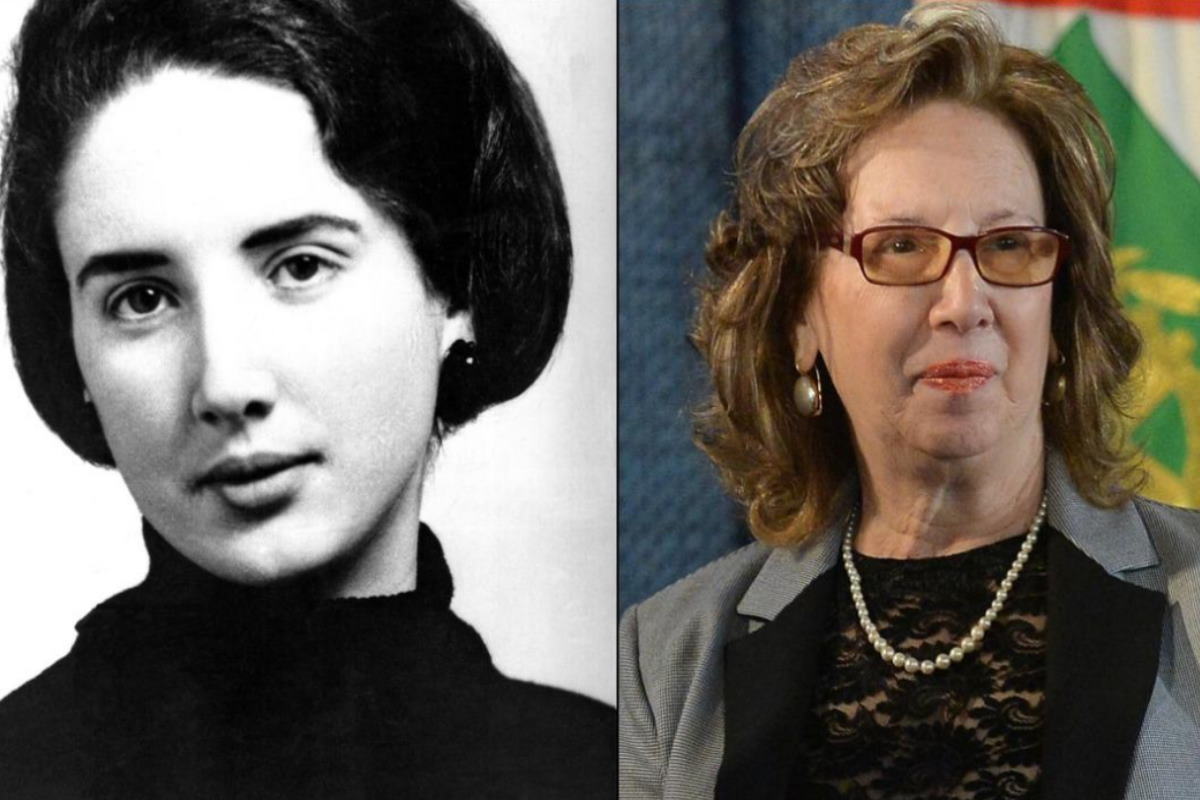
From left to right: Rosaria Lopez, Donatella Colasanti

Sources:

Albinati, Edoardo. La scuola cattolica. Rizzoli: Milan, 2017.


17 April 2024

A Microhistory of my Nonno

Ciao a tutte/i,

What initially began as a project depicting the four main waves of Italian immigration to Canada evolved into a microhistory centred around my paternal grandfather’s life journey. Check out his journey. The link works best with Chrome and on a computer. 

Link here.


Guido D'Elia, 1911-2003


30 December 2023

Navigating Change: The Shifting Tides of Family Life in 1960s Italy

The 1960s marked a period of profound socio-cultural changes in Italy, bringing about shifts in various facets of society. Among these transformations, the evolution of family structures played a pivotal role, reflecting the dynamic interplay of economic, social, and cultural forces. This blog post explores four key aspects characterising the changing landscape of family life during this transformative era. 

Urbanisation and Industrialisation:

As Italy experienced an unprecedented economic boom in the 1950s and 1960s, the lure of better job opportunities drew many from rural areas to the bustling cities. This mass internal migration laid the foundation for urbanisation and industrialisation, reshaping traditional family structures. The once predominant extended families began to give way to smaller, more nuclear units, adapting to the demands and opportunities of urban life.


Smaller Family Sizes:

A notable departure from the historical norm was the decline in birth rates, marking a departure from the large, extended families of the past. Various factors contributed to this shift, including increased access to education and employment for women, the widespread availability of birth control, and evolving societal norms. Families embraced smaller sizes, reflecting a nuanced response to changing economic and cultural landscapes.


Nuclear Family Model:

The rise of the nuclear family became a defining feature of this era. In urban settings, families consisted predominantly of parents and their children, with diminished influence from extended family members. This shift had implications for childcare, decision-making, and support systems within the family unit. The nuclear family model emerged as a response to the demands of an evolving society.


Women’s Changing Roles:

The 1960s witnessed a paradigm shift in gender roles within Italian families. As economic opportunities expanded, more women entered the workforce and pursued higher education. This transformative period challenged traditional divisions of labour within households and contributed to a more egalitarian approach to family responsibilities. The changing role of women in family life reflected broader societal shifts toward greater gender equality.


Oriolo Romano, Lazio, 1965


Gianni Berengo Gardin took the above photograph in Oriolo Romano (Lazio) in 1965. The life and work of Gardin manifest a clear and defined commitment: that of being a comprehensive and unwavering documentary photographer. For Gardin, the role of a photographer involves adopting the position of an observer and choosing an attitude of participatory listening in the face of reality, echoing the practices of the great documentarians of the 20th century. During these years, Gardin consistently stood at the forefront, narrating, as the American sociologist and photographer Lewis Hine would put it, what needed to be changed and what deserved celebration.


With his camera lens, Gardin has long focused on Italy, delving into the realm of labour, capturing its physiognomy and transformations. He also directed his lens towards the condition of women, observing their experiences from north to south, capturing their sacrifices, expectations, and emancipation. Similarly, his attention extended to the distinctive world of the Romani travellers (Rom), a subject to which the author devoted considerable time, love, and numerous literary works.


Much like an ideal storyboard, Gardin’s images offer a visual narrative of the most significant milestones of the country’s recent past. 


Captured in Oriolo Romano (about 40 km northwest of Rome) in 1965, this photograph serves as a visual documentation of the socio-cultural changes caused by the economic transformation within the country during this time. The image shows a discernible shift in attire spanning different generations, notably among females—evolving from long, black dresses to shorter, potentially more vibrant garments that reveal legs, a departure from the traditionally frowned upon practice. The pervasive choice of black attire, conventionally associated with widowers, further underscores the cultural nuances embedded in the visual narrative.


While not overtly apparent, implicit in the image is the suggestion of a family structure characterised by a notably more extensive number of individuals, a phenomenon poised to undergo a subsequent reduction in subsequent years. This nuanced observation hints at the intricate interplay between cultural shifts and demographic dynamics, all intricately woven into the fabric of Italy’s evolving socio-cultural landscape during this transformative period.


Sources:


Petri, Rolf. Storia economica d'Italia. Dalla grande guerra al miracolo economico (1918-1963). Bologna: Il Mulino, 2002.


Silveri, Umberto Gentiloni. Storia dell'Italia contemporanea 1943-2023. Bologna: Il Mulino, 2024.


Testa, Carlo. “La Nuova Italia Del Miracolo Economico: ‘Un Disco per l’estate’ Mezzo Secolo Fa.” Forum Italicum, vol. 49, no. 2, 2015, pp. 674–76, https://doi.org/10.1177/0014585815583292.

06 December 2023

Franca Viola: Symbol of Courage and Resistance against Gender-Based Violence

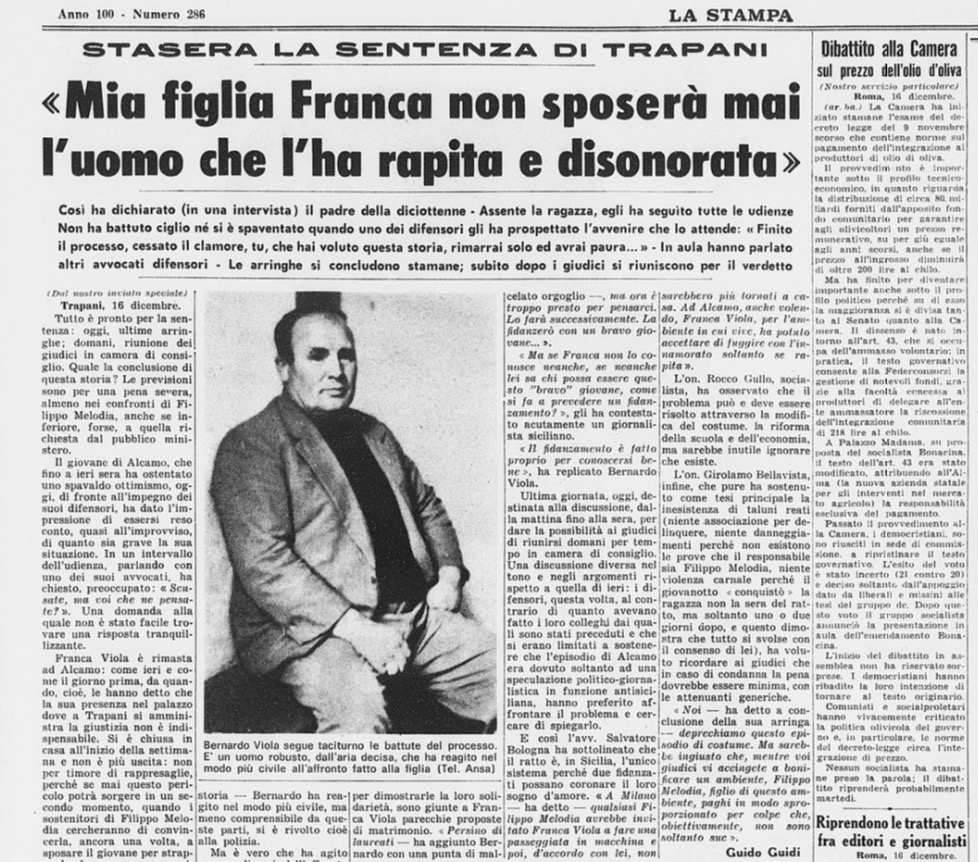
Franca Viola is an Italian woman who became a symbol of courage and resistance against gender-based violence in the 1960s. Her story is particularly noteworthy for the stand she took against a deeply ingrained patriarchal culture.


In 1965, at the age of 17, Franca Viola was kidnapped and raped by a young man (who had connections to the mafia) named Filippo Melodia in the small Sicilian town of Alcamo. Melodia, who was infatuated with Viola, wanted to force her into marriage. However, instead of succumbing to societal pressures and accepting her fate, Viola made a ground-breaking decision: she refused to marry her kidnapper and assailant.  


During this time, it’s important to note that rape wasn’t explicitly considered a crime in the same way it is today. Shockingly, the prevailing cultural norm emphasised the idea that a woman’s honour was tied to her virginity, and the violation of this virtue was treated as a crime against the family’s reputation rather than a crime against the woman herself. In a societal practice known as ‘matrimonio riparatore’ or reparative marriage, families often pressured victims to marry their assailants to restore the family’s honour, perpetuating a cycle of silence and impunity.


Viola’s defiance was an unprecedented act at a time when such crimes were often overlooked or even condoned by society. In a bold move, she pressed charges against Melodia, taking her case to court. This was a revolutionary act that challenged the prevailing notion that a woman’s honour could only be restored through marriage, even if it resulted from a forced union.


The trial that followed became a national milestone, sparking conversations about women’s rights and the need for legal reforms. In 1966, on December 21st, the court ruled in favour of Franca Viola, finding Filippo Melodia guilty of kidnapping and sexual violence. This landmark decision marked a significant step forward for women’s rights in Italy.


Franca Viola’s courage and determination shattered the silence surrounding gender-based violence and forced the Italian legal system to confront the issue. Her case paved the way for changes in legislation, leading to the criminalisation of kidnapping for the purpose of marriage in Italy. Viola’s story remains an inspiring example of resilience and the power of one individual to challenge societal norms and effect change.


Il coraggio di Franca Viola ha cambiato una legge assurda - Una donna al  giorno


Soltanto 42 anni fa l'Italia aboliva il matrimonio riparatore grazie alla  coraggiosa battaglia di Franca Viola - greenMe


La storia di Franca Viola - Il Post


Il 26 dicembre 1965 una ragazzina di 17... - Fiori Di ...


Sources:


Cullen, Niamh. (2016). The case of Franca Viola: Debating Gender, Nation and Modernity in 1960s Italy. Contemporary European History25(1), 97–115. https://doi.org/10.1017/S0960777315000491.


Pavesi, Diletta. “Lo Scandaloso Rifiuto Della Sposa. L’ombra Del Matrimonio Riparatore Nel Cinema Italiano Prima e Dopo Il Caso Franca Viola.” Schermi (Milano), vol. 6, no. 11, 2022, pp. 71–91, https://doi.org/10.54103/2532-2486/16158.


18 November 2023

Unraveling my past

 Benvenute/i! Thanks for stopping by!

I’m a Historian-in-Training based in Toronto, Canada, and Rome, Italy. I’m passionate about migration, oral history, social history, and modern and contemporary Italy. I love social history! Social historians use various primary sources to comprehensively understand how societies have evolved and how individuals and groups have navigated the challenges and opportunities of their time. This interdisciplinary approach helps shed light on the socio-cultural forces shaping our world.

In June 2012, I graduated from York University (Toronto, Canada), obtaining an Honours BA in Italian Studies and Geography and a BEd. I worked as a Flight Attendant for a Canadian airline for about three years and subsequently moved to Rome, Italy, in August 2015. Once in Italy, I taught English as a Foreign Language in public and private Secondary Schools and public universities. I also taught Geography at a public secondary school in Umbria. 

In March 2023, I completed my MA. My thesis, “Past and Present Italians in Canada: Migration Patterns in the 20th and 21st Centuries,” focused on the major changes in Italian migration patterns throughout these past centuries.

I’m currently pursuing a PhD in History at York University. My research interests include Italian migration (primarily to and from Canada), modern and contemporary Italian and European history, identity formation, and social history. 

I really appreciate Alessandro Portelli’s work on oral history, historian Dirk Hoerder’s contributions to the field focusing on complex ‘migration systems’, and historian Donna Gabaccia’s shift towards a global approach to studying the phenomenon. 


Stay tuned for more!


I took this photo in July 2021. In the distance, you can see a picturesque hilltop village in the Monti Sibillini called Castelluccio di Norcia in the Umbria region. Castelluccio is renowned for its stunning natural beauty and is particularly famous for its colourful and expansive highland plain known as the “Piano Grande”. Castelluccio is located approximately 1,450 metres above sea level. One of the most striking features of Castelluccio di Norcia is the flowering of wildflowers that occurs in late spring and early summer on the Piano Grande called la Fioritura (locally known as la Fiorita). The hillsides burst into vibrant colours, with red, blue, yellow, and purple flowers creating a breathtaking mosaic of hues. This natural phenomenon has become popular, drawing photographers, hikers, and tourists worldwide. If you love snow, I highly recommend visiting during the winter months. 

To purple and beyond!

Unveiling the 'Marocchinate'*: The Tragic Echoes of WWII in Italy

Introduction In the tumultuous aftermath of World War II, many stories of suffering and hardship have emerged from the shadows of history. O...